
Milan-San Remo 1910: the hardest ever
It was 6 a.m. on April 3, 1910, in central Milan. The fourth edition of Milan-San Remo was about to begin, but the weather was horrendous. Heavy rain poured down, and reports of a snowstorm on the route loomed over the riders. Of the 256 registered cyclists, only about 70 showed up for the start. Several decided at the last minute that they didn’t feel like racing after all and returned to their hotels.
Eventually, 63 riders lined up. Most of the big names in cycling were present, including the 1909 winner Luigi Ganna, the 1908 winner Cyrille van Hauwaert, and the 1910 Paris-Roubaix champion Octave Lapize (back then that race took place in March).
The riders set off on their 300-km adventure at 6 in the morning. Despite the horrible conditions, they managed to cover 32 km in the first hour. However, the relentless rain and cold led several riders to abandon the race and turn back to Milan.
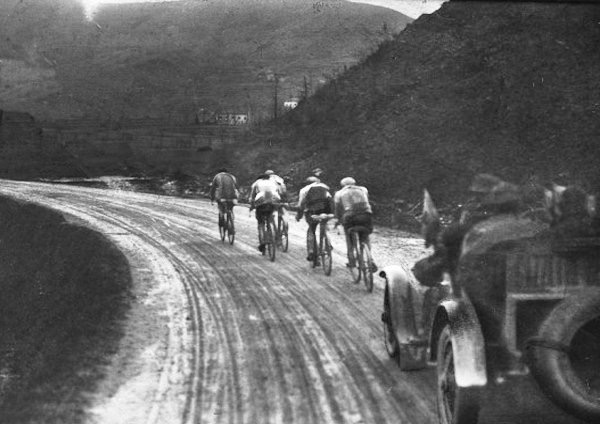
As the remaining competitors approached the foot of the Turchino Pass, the rain turned to hail and snow. The riders were woefully unprepared for such conditions, dressed in wool jerseys and short bibs. The 26-km-long climb, ascending to an elevation of 532 meters, turned into a true nightmare. The unpaved roads quickly became impossible to ride. Many riders dismounted, pushing their heavy bikes up the climb through snow and icy slush. By the time they reached Masone, only 30 riders were still in the race.
After five hours, Belgian rider Cyrille Van Hauwaert was the first to crest the Turchino Pass. He had attacked earlier on a bridge crossing the Po River and built a 10-minute lead. The chasing group crashed when crossing tram tracks on a corner, giving Van Hauwaert a bigger advantage.
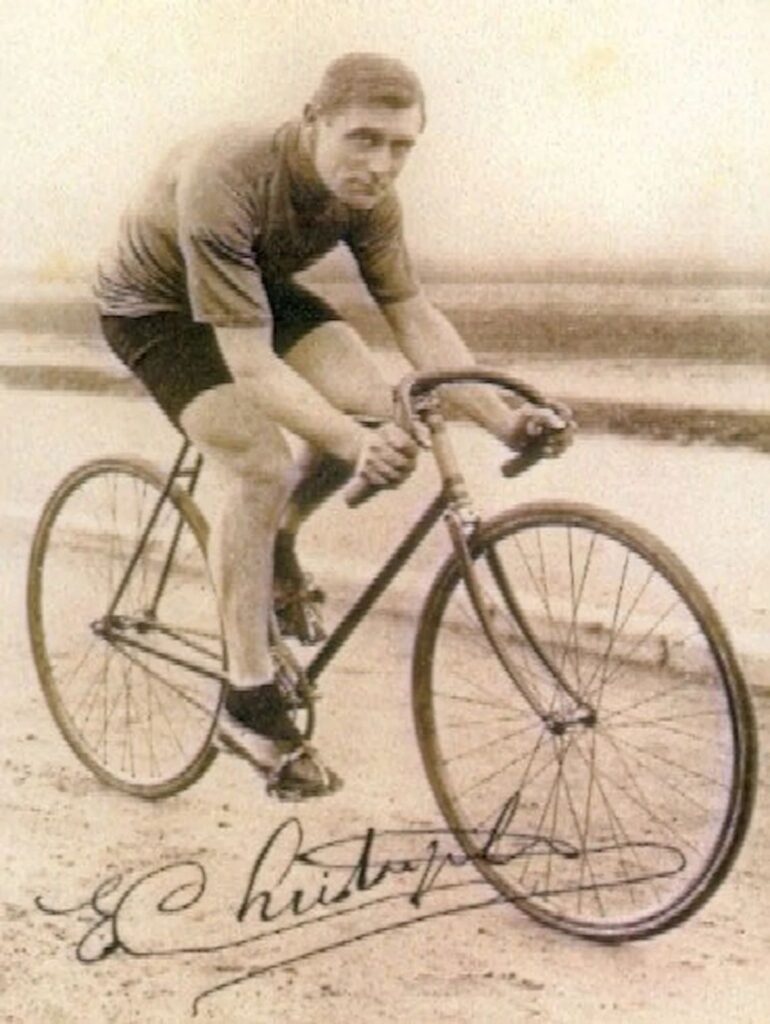
But Van Hauwaert was frozen to the bone. He sought shelter in one of the tunnels to warm up, which cost him the race lead. Frenchman Eugène Christophe, a relatively unknown rider but in strong form after finishing third in Paris-Roubaix a week earlier, took over at the front.
Christophe’s lead didn’t last long as he crashed on the snowy descent. The details are unclear, but he ended up being rescued by the owner of a roadside tavern. The innkeeper undressed him, gave him food and dry clothes, and helped him warm up. Later, Van Hauwaert and third-placed Ernest Paul also arrived at the same tavern, utterly defeated by the icy weather.
Van Hauwaert and Paul decided to abandon the race, but Christophe was determined to continue. He made up an excuse to convince the innkeeper to let him leave. Wearing a fresh pair of long trousers, he set off in pursuit of the Italian duo Pierino Albini and Luigi Ganna, who were now leading the race.
Christophe was unstoppable. He passed Albini and Ganna with 120 km to go and built a lead of 15 minutes. His advantage was so great that he stopped to change bikes and eat some food. He also cut his trousers as they kept getting caught in his chain.
After navigating the final stretch, Christophe finally arrived in San Remo with a lead of over 45 minutes. However, he struggled to find the finish line. Races at the time weren’t held on closed roads and he had to ask pedestrians for directions at multiple crossings.
Eventually, Christophe found the finish line after 12 hours of racing. Ganna arrived 40 minutes later but was disqualified for taking a car on the Turchino Pass. Two other Italians were also disqualified, though it’s unclear if they even made it to San Remo. Official results listed just four finishers.
Christophe’s body was broken after the race. He spent a month in the hospital recovering from frostbite. Later, he stated that it took six months to regain his health and two years to return to his previous level of fitness.
There is a funny, but untrue, myth surrounding Christophe’s victory in San Remo. According to the tale, he locked eyes with an attractive woman while drinking coffee after finishing the race. Unable to resist his magnificent mustache, the woman lured him to a hotel, where she allegedly robbed him of his jersey and spare tire.
The race that nearly broke Anquetil, but ended Poulidor
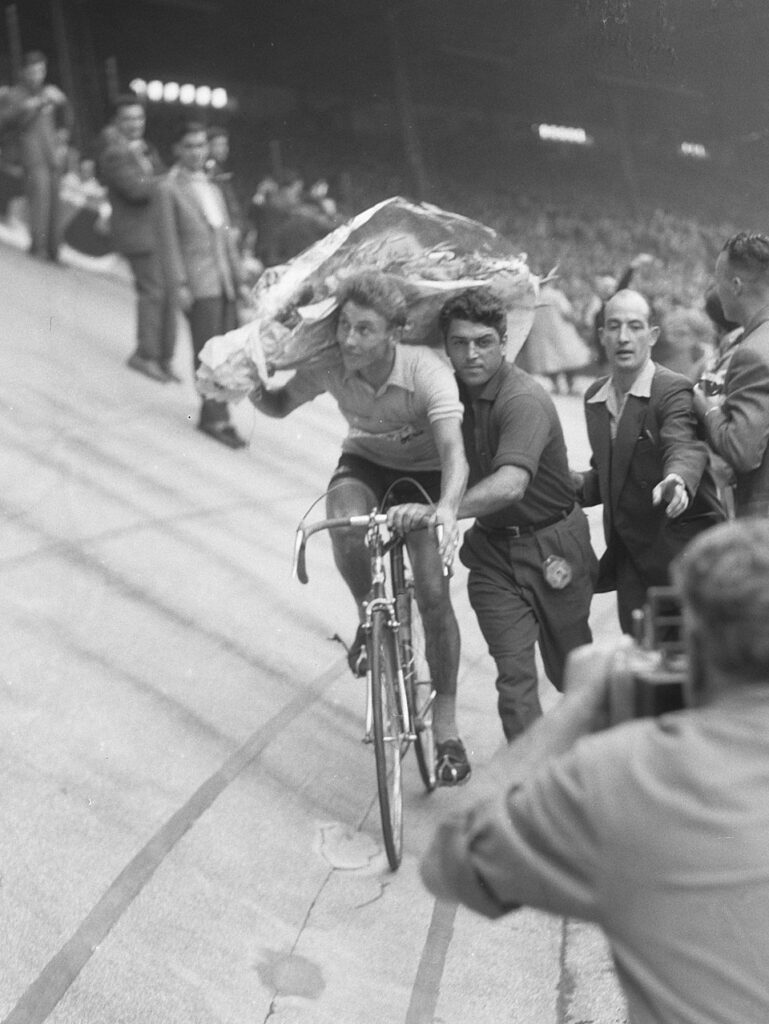
After the epic Tour de France battle in 1964, Jacques Anquetil took a year off Grand Tour racing. At that time, riders earned most of their revenue from criteriums, and Anquetil knew that additional Tour de France wins wouldn’t boost his value. Past his prime, he decided to cash in on his reputation by racing numerous criteriums.
Still, Anquetil showed why he was the best rider of his era. After winning the final stage of the Dauphiné, he boarded a private jet to start Bordeaux-Paris at midnight. Having only taken a short nap, he went on to win the 600 km race.
Anquetil was annoyed that this performance was given little media value because he wasn’t racing against Poulidor. However, his eternal rival had his own problems. Without Anquetil, 1965 seemed like the perfect opportunity for Poulidor to finally win the Tour, but he ended up behind Felice Gimondi.
Poulidor and Anquetil met again in Paris-Nice 1966. After five sprint stages, the riders reached the island of Corsica with the general classification still wide open. The hilly morning stage was marked by the abandonment of 25-year-old outsider Roger Pingeon, who announced his retirement after a mental breakdown. A year later, he would go on to the Tour de France.
That afternoon, the riders faced a 36-km time trial in stage 6b. The course through the hills was described as the most beautiful race against the clock ever witnessed in cycling, featuring more than 300 corners and no straight section longer than 200 m. For Anquetil, this was bad news. Although he was a time trial specialist, he couldn’t use his big gears on this course, while Poulidor mastered the short, sharp efforts required on such terrain. Inevitably, Poulidor beat Anquetil at his own game.
Anquetil’s biography describes his reaction to this defeat: he was furious at being beaten in his specialty, furious at the warm reception Poulidor received from the Corsican fans, and furious at having lost Paris-Nice. He was so enraged that even his wife, Janine, had to keep her distance.
On the other hand, Poulidor’s fans were optimistic. Poulidor dropped Anquetil in stage 7, forcing him to take massive risks on the descent in order to catch up. Although Anquetil did manage to come back, he started the final day 36 seconds behind.
Stage 8a was the final mountainous stage. Anquetil, with the help of his Ford team manager Raphaël Géminiani, plotted an ambush by fitting his 180-mm TT crank and big front chainring onto his regular bike for the stage. The stage descended into chaos as Anquetil’s Ford team put Poulidor’s Mercier team under constant pressure from the start. There were a dozen attacks from both sides, but midway through the stage, both riders had to work together when Vittorio Adorni, third in the general classification, attacked. Once Adorni was caught, the battle resumed.
Poulidor is reported to have followed 38 attacks by Anquetil, but the 39th proved fatal. On the shallow climb to Tourettes-sur-Loup, Poulidor cracked. Anquetil flew down the descent of that final climb before shifting to his big TT gear.
Anquetil hated Poulidor, never wanting to admit defeat to him. Pushing as hard as he could, Anquetil reached Nice after a solo effort of 35 km. His lead on the peloton of over a minute was more than enough to secure victory in Paris-Nice. Stage 8b had no effect on the final outcome.
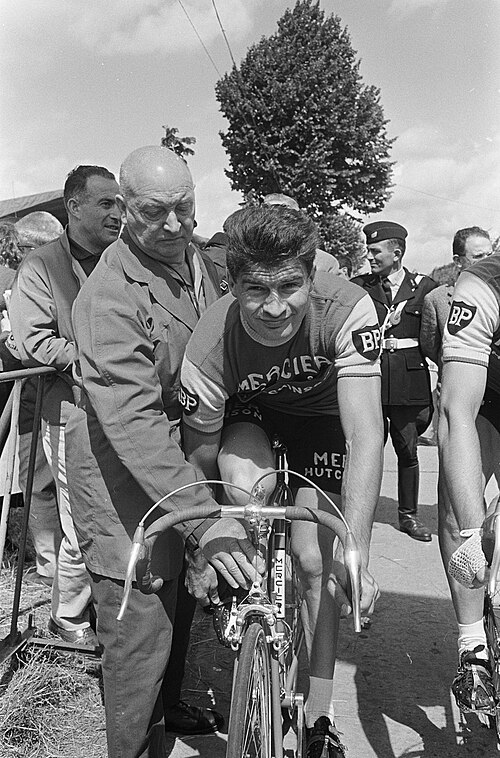
After the race, Poulidor complained about the behavior of Anquetil’s Ford team, claiming several of his Mercier teammates had been pushed, one even ending up in a ditch. In response, Anquetil called Poulidor a crybaby. Later, Ford rider Jean-Claude Wuillemin admitted to pushing Mercier rider Barry Hoban into a ditch, but nothing changed the race results.
This battle completely reignited the rivalry between Anquetil and Poulidor ahead of the Tour de France, where they were the favorites. A win in his final Tour would put Anquetil at six overall wins; for Poulidor, it would have been his first. The first stage was won by the German Rudi Altig (Molteni), who held the yellow jersey until stage 10.
The race had been calm, but that changed when the peloton entered the Pyrenees. In stage 10, which featured the Aubisque, Anquetil and Poulidor only had eyes for each other and allowed a 21-man breakaway to go. The break included outsiders such as Cees Haast (Televizier), Jan Janssen (Pelforth), and Anquetil’s teammate Lucien Aimar. They gained seven minutes on the two French rivals.
Anquetil and Poulidor made a costly mistake. Seven minutes is a lot of time to recover from, even for two cycling champions. They attacked the following day and gained back one minute on Janssen and two minutes on Aimar, while Haast cracked and lost four minutes.
Stage 14b was a 20-km time trial. Anquetil, nicknamed “Mr. Chrono,” was surprisingly beaten by Poulidor. The gap was small, just seven seconds, but it was a sign that Anquetil wasn’t at his best.
In stage 16, Poulidor escaped with Anquetil. They gained one minute on Aimar and Janssen, but the situation was dire for Anquetil. He was 45 seconds behind Poulidor in the GC, outclassed on every terrain. From that point on, he worked so Aimar would win the Tour, but more importantly, so that Poulidor would lose.
In stage 17, Aimar was dropped early on, but Anquetil ensured that he and his teammates worked hard. Later, Aimar managed to sneak away on a category 3 climb, gaining two minutes and leading the GC by 1’30″ over Janssen.
Anquetil was Aimar’s personal lieutenant in stage 18, responding to every attack by Janssen. Later in the stage, Poulidor escaped, but Anquetil managed to limit the gap to 50 seconds. Poulidor was still 4’10″ behind. Anquetil’s work was done; he retired from the race due to “illness”.
Aimar lost 2’20″ to Poulidor in the final TT, but it was more than enough to win the Tour. Janssen finished second, 1’07″ down, and Poulidor was third at 2’02″.
Aimar, Poulidor, and Anquetil all headed to the World Championships held on the Nürburgring later that season, now as teammates on the French national team. Poulidor and Anquetil agreed to not attack each other during the race, but French media speculated that little would come from the agreement.
Poor internal relations within the French team led some to believe that Altig was the top favorite on home soil. Other favorites were the young Belgian Eddy Merckx and Italian Felice Gimondi.
The favorites saved themselves while several dangerous groups were brought back by a mix of countries working together. Deep into the final, eight riders got away: Gimondi, Merckx, Anquetil, Poulidor, Jean Stablinski (France), Italo Zilioli, Gianni Motta (Italy), and Martin Van Den Bossche (Belgium).
Everyone thought this group of favorites would go to the end, but it didn’t. Motta annoyed the Italians by blocking for his trade teammate Altig, who was in the chasing group. Poulidor and Anquetil refused to work together, so the pace remained low. Partially due to the work of the Frenchman Aimar, a second group came back. In this group was Altig, by far the fastest sprinter left at the front of the race.
Shortly after regrouping, Altig decided to attack. He was followed by Anquetil, Poulidor, Stablinski, Zilioli, and Motta. Despite their numerical advantage, the French didn’t attack, and the race came down to a long uphill sprint.
Altig launched with 500 m to go. The rest were no match for the German, who had plenty of time to sit up and celebrate the world title. Anquetil was so disappointed with second place that he didn’t show up for the podium, while Poulidor placed third.
Despite Anquetil’s disappointment, there was much speculation that he wanted Altig to win. Anquetil had visited Altig’s home together with Stablinski, and it was later revealed that Anquetil and his wife even slept at Altig’s house the night before the race. It led to heavy media speculation that Anquetil had conspired with Aimar and Stablinski to prevent Poulidor from winning the world title. Anquetil always denied this.
The 1966 World Championships marked the final chapter of the Anquetil-Poulidor rivalry. Anquetil postponed his retirement by two years to pay for a new château he had purchased, but cut back his schedule. Jacques Anquetil died in 1987 of stomach cancer.
Anquetil’s personal life, however, became the subject of scandal after his death. He was married to Jeanine, who had two children from a previous marriage, but couldn’t have any more kids. With Jeanine’s consent, he fathered a daughter with her 18-year-old daughter, Annie. The three lived together in a ménage à trois for 12 years until Annie left. Anquetil then became romantically involved with Dominique, his stepson Alain’s wife, with whom he had a son. This series of events ultimately led to the disintegration of the family, with Jeanine and Annie leaving him with his daughter, and Alain also moving away.
Poulidor continued racing for several seasons, but would ultimately never win the Tour de France. With eight podium places, he is usually credited as the best rider to never win the Tour. After his career, he became a beloved figure in the Tour caravan, working for Crédit Lyonnais, the sponsor of the yellow jersey. Poupou died in November 2019, at age 83.
The downfall of Frank Vandenbroucke
Following his victory in Liège-Bastogne-Liège 1999, the logical next step for Frank Vandenbroucke was to make his Tour de France debut. His French team, Cofidis, was thrilled by the publicity their rising star was generating. However, their excitement dimmed when Vandenbroucke was involved in a doping case involving Dr. Bernard Sainz.
Sainz, known as ‘Dr. Mabuse’, began his dubious career as a drug dealer in equestrian sports before expanding into cycling, where he quickly earned a notorious reputation. Vandenbroucke claimed that, as far as he knew, he had only been given homeopathic remedies. The authorities believed him and cleared him of any wrongdoing, but the case left lasting damage.
During this time, Vandenbroucke was barred from racing. He felt his reputation had been unfairly damaged, especially since he believed he was doing what most riders were. He spiraled into drug use, struggled with depression, and called off his engagement to Clotilde Menu.
Cycling became Vandenbroucke’s way out of his problems. He resumed training and returned to competition in late August, finishing ninth at the GP Plouay. Despite all the controversy, he met with Sainz after the race. Determined to become world champion, Vandenbroucke followed Sainz’s advice and entered the first week of the Vuelta a España as preparation.
He arrived at the Vuelta’s gran salida with just two jerseys in his suitcase, fully expecting to withdraw after a few stages. Taking it easy in the opening stages, he decided to test his legs during stage 5. Vandenbroucke survived the mountain stage with the top 20 riders but missed his chance in the sprint, finishing third.
Afterward, his attention was caught by a woman, Sarah Pinacci, working as a model promoting the Saeco team. For Vandenbroucke, it was love at first sight. At first, she was hesitant to interact with Vandenbroucke. She always thought she never wanted to date a cyclist, but Vandenbroucke slowly persuaded her.
This burgeoning romance gave Vandenbroucke a reason to remain in the Vuelta beyond his original plan. He kept telling Sainz and his team, “Just one more stage, just one more climb.” Despite leaving the hotel at night to meet with Sarah, his results remained solid.
After stage 15, they shared dinner in Valencia. Over a few too many glasses of wine, Vandenbroucke made a bold promise: “Tomorrow, I’ll win the stage. The flowers will be for you.”
Vandenbroucke was a man of his word. He, all alone, bridged a big gap to a 14-man breakaway, just to shatter the group apart with 50 kilometers remaining. Only Banesto rider Jon Odriozola managed to hold his wheel.
Sitting on the wheel was all Odriozola could do. Then, Banesto’s team car pulled alongside, offering money if Vandenbroucke allowed Odriozola to win. In response, Vandenbroucke increased the pace, nearly dropping Odriozola. He countered with his own proposal: “I’ll take the win, and Odriozola gets second.” According to Vandenbroucke, Banesto agreed. He claimed victory and gave the flowers to Sarah.
The following stage was, once again, supposed to be his last in the Vuelta. After saying Sarah goodbye, they shared their first kiss. Ecstatic, Vandenbroucke decided to remain in the race. He claimed an impressive second place on the Alto de Abantos the next day.
That evening, he demanded to see Sarah, even though she was over an hour away in Madrid. Threatening to quit the Vuelta, he persuaded a soigneur to drive him there. They arrived at midnight under the condition that the visit would last just one hour. Vandenbroucke stayed the night, leaving the soigneur to sleep in the hotel lobby.
Vandenbroucke made a new deal with Sarah: if he won the stage the next day, they would be intimate. Once again, Vandenbroucke kept his promise, dropping everyone on the final decisive climb. He thought a 25-kilometer solo effort was too boring, so he waited for his rivals, only to destroy them on a short, cobbled climb to the finish. Like this, he won his second stage.
In the remaining stages, Vandenbroucke exceeded expectations. He finished third in the time trial and attacked in the final criterium through Madrid, winning both intermediate sprints and securing the points classification victory.
Two weeks later, Vandenbroucke started the World Championships in Verona as the main favorite. However, with four laps to go, he crashed and broke both wrists. Remarkably, he continued racing and even attacked in the final lap. Although he opened a gap, he was in too much pain to sustain it, finishing in a respectable seventh position. He and Pinacci became a couple.
After this successful end to 1999, Vandenbroucke struggled in 2000. The Belgian felt immense pressure to perform. Not only was he the leader of Cofidis, but he also felt the weight of a nation expecting him to win the Tour de France, despite not being a true Grand Tour rider.
At heart, Vandenbroucke, was a puncher who excelled in one-week stage races. A Grand Tour general classification was beyond his reach, which gave him a sense of guilt and inadequacy.
To escape these feelings, Vandenbroucke turned to drugs. He often went out, combining alcohol with recreational drug usage. In Belgium, it became a major news story when he was caught driving under the influence. His drug addiction was believed to have originated with sleeping pills, which were introduced to him by his Cofidis teammate Philippe Gaumont.
The nadir of his 2000 season came at Paris-Nice. Terrified of what would happen if he underperformed, he broke his fingers with a hammer, claiming he had fallen down the stairs to avoid starting the race.
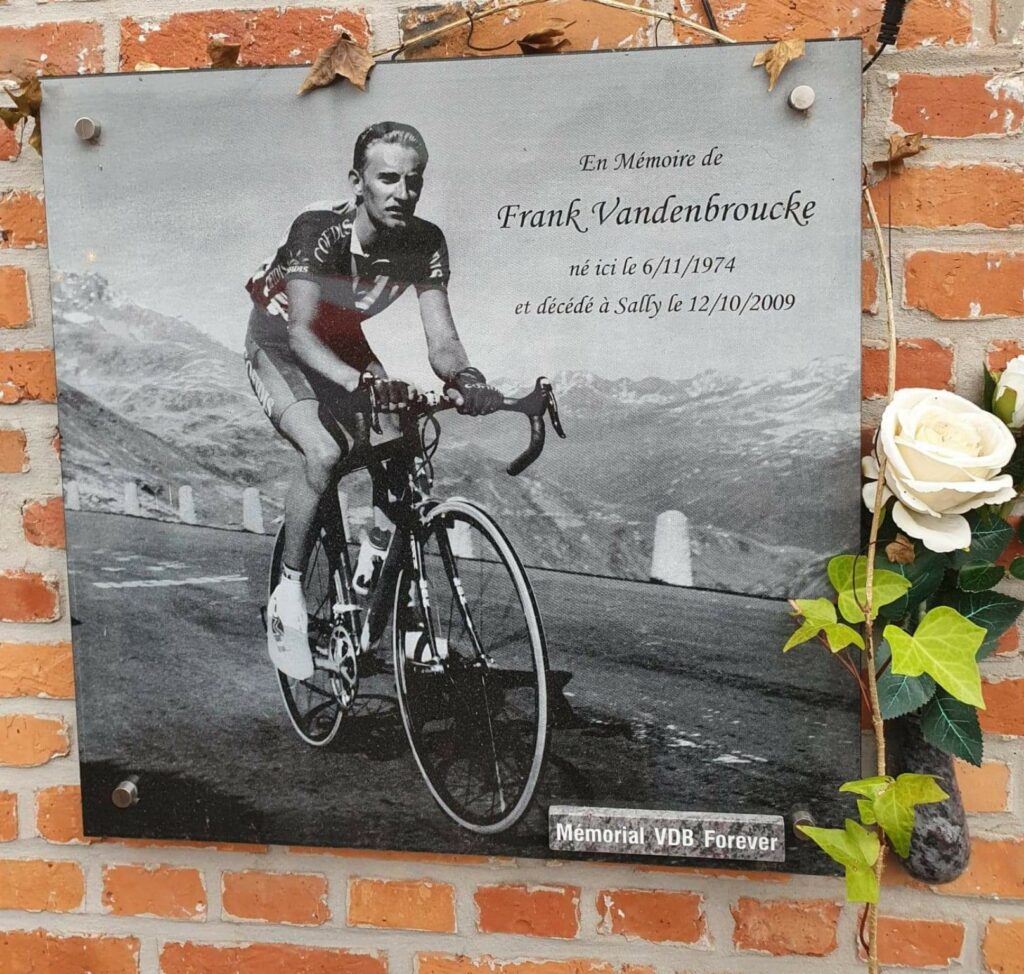
Vandenbroucke moved to Lampre in 2001, but his problems persisted. At the team presentation, he was described as “a mummy with hollow eyes, holding himself up against the wall.” He had barely slept the night before due to drug use. Midway through the season, Lampre fired him.
Pinacci, now his wife, sought help to revive her husband’s career. A small team helped rebuild the talented Belgian. He stopped using drugs and began training again, starting with running, then swimming and badminton.
In the 2002 preseason, Vandenbroucke impressed. His former team boss Patrick Lefevere gave him another chance, providing the structure he needed. Things looked promising until the police found EPO, morphine and clenbuterol in his house.
Vandenbroucke stated that the EPO and morphine were leftovers he forgot he had. They were expired, so why would he use them? The clenbuterol was for his sick dog. He underwent a doping test, which came back negative.
Vandenbroucke was suspended for six months, but Lefevere kept faith in his protégé. The mental impact of the case was however tremendous for Vandenbroucke. The trial was a media circus, leaving the Belgian feeling humiliated. Nevertheless, he continued working hard, resulting in a second place in the 2003 Tour of Flanders.
Vandenbroucke lost that Tour of Flanders in a sprint against Peter Van Petegem. Within the peloton, a rumor was spread that Vandenbroucke sold the win to Van Petegem for 7 million francs, but had kept all the money for himself, instead of sharing it with his teammates. Due to this, Vandenbroucke’s position within QuickStep became untenable. He left for Fassa Bortolo, where his old problems resurfaced.
In 2004, a fight between Vandenbroucke and his wife ended in a suicide attempt by Vandenbroucke. The couple divorced shortly after.
Vandenbroucke kept racing for multiple Pro Continental teams, but he was more in the news for his private problems rather than his cycling results. In 2007, he was hospitalized after another suicide attempt. He was later admitted to a psychiatric clinic.
Vandenbroucke frequently used drugs, but a weight seemed to fall off his shoulders when he announced his retirement in 2009. He got clean and was looking forward to improve his life.
Vandenbroucke died a few months later at the age of 34, while on holiday in Senegal. The official cause of death was pulmonary embolism. A prostitute and two other men were arrested for stealing his possessions. L’Équipe reported that Stilnoct, Xanax, and insulin were found next to his bed, fueling the theory of suicide. Family and friends of Vandenbroucke believe he was drugged by the people who stole his possessions.
Marvelous Roubaix
Paris-Roubaix 2016 had a rapid start as a strong group of 20 riders broke clear early on. Astana, with outsider Lars Boom, was the biggest team to miss the move. They chased for two hours, only to see a new group of 16 riders break clear once the first break was caught.
The other favorites were able to sit comfortably in the peloton. The main favorite was Peter Sagan (Tinkoff). The world champion had a great spring, having won Gent-Wevelgem and the Tour of Flanders. His biggest rivals were the retiring Fabian Cancellara (Trek) and Sep Vanmarcke (LottoNL).
Tom Boonen (QuickStep) was also considered a contender, though largely due to his reputation. Since his fourth Roubaix victory in 2012, he had been plagued by bad luck. A crash in the 2015 Tour of Abu Dhabi disrupted his preparation for 2016. With speculation about retirement, his results leading up to Roubaix were underwhelming. However, he had strong support from teammates Niki Terpstra and Zdeněk Štybar.
With 117 km to go, QuickStep and LottoNL pushed the pace on the Quérénaing cobbles when a crash near the front split the peloton. While the damage initially seemed minor, the high pace eventually shattered the bunch. QuickStep and LottoNL had numbers in the front group, while Cancellara and Sagan were caught behind.
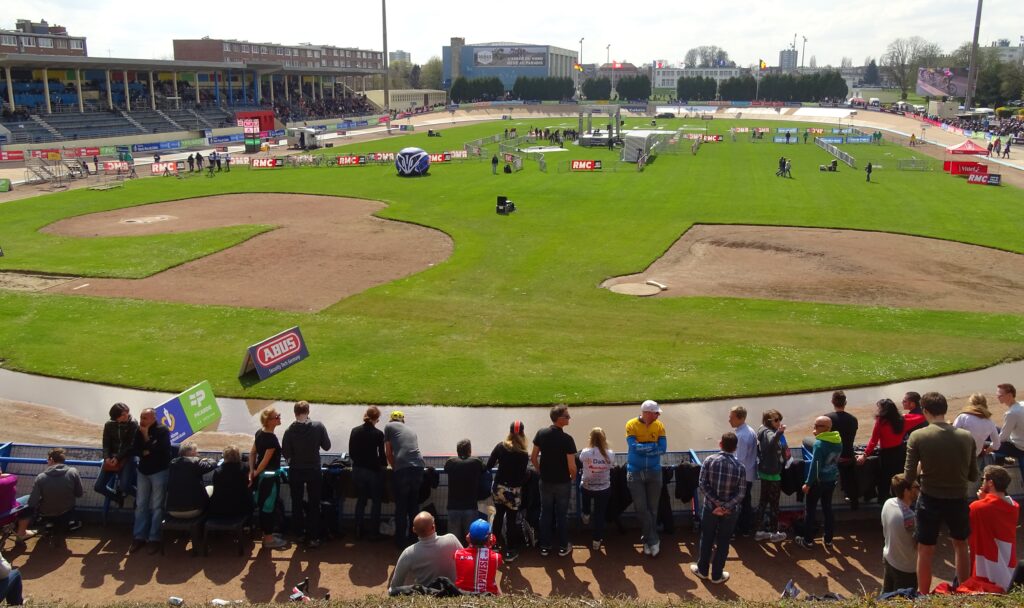
QuickStep burned through its domestiques to gain a lead of 1’10″. With 100 km to go, Boonen attacked on the four-star Haveluy sector. His teammate Tony Martin, Luke Rowe (Sky), Robert Wagner (LottoNL), Edvald Boasson Hagen (Dimension Data), and Luke Durbridge (Orica) were able to follow. Notably, Vanmarcke was missing as he suffered a mechanical.
After a chase of 20 km, Vanmarcke’s group caught back up to Boonen. LottoNL and Sky both had four riders, and contributed to the chase which was mainly led by Martin. This group of 17 held a 45-second advantage over the Sagan-Cancellara group.
With 60 km to go, the early break was caught and all cooperation up front was gone. As Cancellara was informed about the several attacks up front, he attacked from the chasing group with Sagan and Ramon Sinkeldam (Alpecin). The trio managed to bring the gap down to 25 seconds, but couldn’t close it entirely. A bit later Cancellara crashed on the slippery cobbles of Mons-en-Pévèle, taking the entire chasing group out of contention.
It was clear that the winner was up front. Sky had however lost its numerical advantage, as Gianni Moscon, Luke Rowe and Salvatore Puccio crashed within minutes of each other. This left Ian Stannard as Sky’s only remaining rider in the front group.
Stannard had a great day. When Vanmarcke attacked on Mons-en-Pévèle, he was the only one directly on the wheel. Boonen managed to bridge across with seven riders in his wheel.
The leading group of ten was reduced to just five riders in the 30 km between Mons-en-Pévèle and Carrefour de l’Arbre. Vanmarcke appeared to be the strongest rider, controlling most attacks. The five riders starting Carrefour de l’Arbre together were: Boonen, Boasson Hagen, Vanmarcke, Stannard and Matthew Hayman (Orica). Hayman was a survivor from the early break.
On the Carrefour de l’Arbre, Vanmarcke launched a blistering attack. He took severe risks in the corners to open up a seven-second lead with 16 km to go, but he got reeled in just four km later.
The final five-man group was a fascinating mix. Boonen was chasing a record-breaking fifth Roubaix title, Vanmarcke was hoping to finally win a Monument after years of bad luck, while Boasson Hagen and Stannard were outsiders dreaming of the biggest victory of their careers.
The biggest surprise up front was Hayman. Although far from a household name, Hayman was a solid classics rider, having previously finished eighth and tenth in Paris-Roubaix. He had also placed third in Dwars door Vlaanderen and Omloop Het Nieuwsblad earlier in his career. What made his presence even more remarkable was that he had broken his elbow in Omloop Het Nieuwsblad a few weeks earlier. After a month of only indoor training, he returned to racing just a week before Roubaix.
With 10 km to go, Vanmarcke attacked on the Hem sector, but was caught. Stannard then made his move, but that was also unsuccessful. With 5 km remaining, Hayman’s attack had the same destiny.
Boonen was the strongest sprinter at the front, but with 4 km to go he launched an attack of his own. However, everyone closely marked his wheel, so he didn’t get away. His move did make him vulnerable to a counterattack, and just as he sat up, Stannard attacked. It required a massive push by Boonen to bring him back.
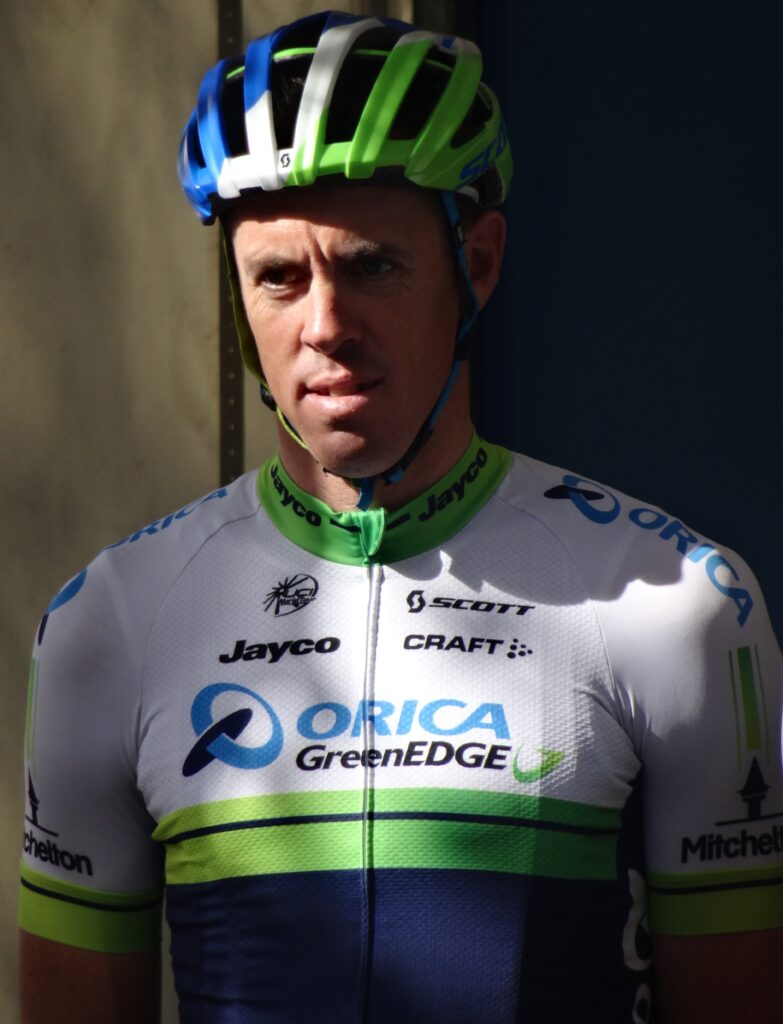
With 2.8 km to go Boonen launched another big attack. By now, several riders were too fatigued to follow and the Belgian gained a 3 second gap. Hayman was the only one who still had the legs to react, he attacked from the chasing group and immediately passed Boonen.
With a final push, Boonen managed to get back on Hayman’s wheel. The two entered the velodrome together, but their slowing pace allowed Vanmarcke to rejoin them.
Boonen led the trio past the famous final lap bell, keeping a steady tempo with two chasers close behind. As they approached the final sprint, Hayman was the first to launch. Boonen seemed caught off guard by this early move. Hayman took the lead, while Vanmarcke passed him on the outside of the final corner as well.
Boonen was boxed in on the inside line through the final corner. On the home straight he finally found a gap and pulled alongside Hayman, but the finish line came too soon. Hayman held on to complete a stunning victory.
It was Hayman’s first win since Paris-Bourges in 2011. He had entered Paris-Roubaix without ambitions due to his injury, yet now he was a Monument winner. It would also be the final win of his career. He retired after the 2019 Tour Down Under.
The second place was a huge disappointment for Boonen, but he admitted it was ultimately his own fault. He made a final bid to win a fifth Roubaix the following year, but he finished in the second group. Paris-Roubaix 2017 was his final race.
Boonen retired one year after his long-term rival Cancellara. After his crash on the cobbles, the Swiss crashed again on the velodrome. The three-time Flanders and Roubaix winner got a worthy farewell to the sport that summer. Fabian Cancellara retired directly after winning Olympic Gold in the time trial.